

What is the untapped potential of the EU Single Market?
Prepared by Roberto Bernasconi, Naïm Cordemans, Vanessa Gunnella, Giacomo Pongetti and Lucia Quaglietti
1 Introduction
The EU Single Market brings together 450 million people and 26 million businesses. It is one of the cornerstones of European integration, serving as a dynamic engine for welfare gains, competitiveness and resilience. By facilitating the free movement of goods, services, capital and labour, it has enhanced economic efficiency through economies of scale, stronger competition and increased innovation. ECB research indicates that between 1993 and 2014 the Single Market increased real GDP per capita by 12-22% across founding Member States (Lehtimäki and Sondermann, 2020), while studies by Mion and Ponattu (2019) estimate average annual welfare gains of around €840 per person, expressed in 2016 prices.
The Single Market delivers broad economic and strategic benefits for the EU and its Member States. A well-functioning Single Market improves productivity and resilience because it provides the scale for companies to innovate and grow. It also promotes price convergence and strengthens the transmission of monetary policy, which are of particular relevance to the ECB. Moreover, as underlined by Letta (2024) and Draghi (2024), it stands as Europe’s first line of defence in the face of a rapidly evolving geopolitical landscape.
However, the Single Market continues to face structural obstacles that prevent the realisation of its full potential. Remaining barriers – particularly to the cross-border provision of services, but also to the circulation of goods and the free movement of labour and capital – limit the depth of integration and the scope of potential welfare gains.[1] Overcoming these limitations is essential for further strengthening the EU’s resilience, fostering competitiveness, enhancing defence capabilities and safeguarding economic stability.
This article assesses part of the untapped potential of the Single Market, specifically addressing the circulation of goods and services. The first section briefly traces the historical development of the Single Market and examines the current degree of trade integration. The second section describes the barriers that impede the free movement of goods and services within the EU. The third section quantifies the scale of the barriers through the lens of a gravity model. And finally, the fourth section assesses the potential welfare gains achievable through further integration.
2 Current level of integration of goods and services in the Single Market
The Treaty of Rome, which created the European Economic Community (EEC), laid the foundation for a common market and customs union. The 1957 Treaty introduced the “four freedoms”: the free movement of goods, services, capital and people. The initial emphasis was on reducing customs duties and quotas on goods, which were fully eliminated by 1968 with the creation of the EEC customs union. The Single European Act of 1986 set the goal of a fully integrated internal market by tackling non-tariff barriers, paving the way for the Single Market’s official launch in January 1993. For goods, it removed customs formalities, reduced technical barriers through mutual recognition and replaced VAT border checks with harmonised rules. For services, the Services Directive adopted in December 2006 addressed obstacles to cross-border provision, with the aim of removing discriminatory practices based on nationality or residence and fostering administrative cooperation.[2]
Removing barriers to the movement of goods has resulted in rapid EU goods trade integration, while services markets remain less integrated. Chart 1 compares intra-EU and extra-EU trade, used as an indicator of the degree of integration within and outside the Single Market respectively. Trade in goods has clearly benefited from deeper integration within the EU, which is not the case for services. In 2024 cross-border trade in goods within the EU accounted for over 40% of EU GDP, up from 30% in 1999 and around 16 percentage points higher than trade between the EU and the rest of the world. Over the same period, intra-EU trade in services rose from 8% of GDP in 1999 to 16% in 2024, a level very similar to extra-EU trade in services. This contrast between goods and services integration is all the more striking given that services account for nearly three-quarters of economic activity in the EU.
Chart 1
Intra-EU and extra-EU trade
a) Goods market |
b) Services market |
|---|---|
(percentage of nominal GDP) |
(percentage of nominal GDP) |
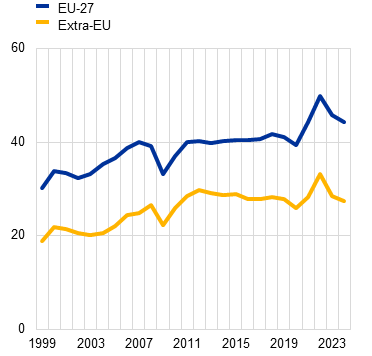 |
 |
Sources: Eurostat and ECB calculations.
Comparatively low services trade integration can be attributed, in part, to the localised nature of services. Many services, such as healthcare, education, legal consultancy or real estate, may require proximity to the consumer or adaptation to local cultural, legal or linguistic contexts, making cross-border provision more challenging. To some extent, it also reflects the fact that a significant share of service provision occurs via the establishment of subsidiaries or branches.[3]
The depth of Single Market integration varies significantly across subsectors. Highly harmonised manufacturing industries such as motor vehicles, chemicals and electronics benefit from EU-wide standards, mutual recognition agreements and extensive cross-border supply chains. For example, the automotive sector relies on cross-border supply chains for parts and assembly, while chemicals and electronics benefit from harmonised EU standards that ease trade across Member States. In contrast, primary goods, such as food products and pharmaceutical products, remain far less integrated because of a combination of national regulations, differences in standards and logistical barriers, as well as non-policy determinants such as cultural factors, consumer preferences and limited tradability of certain products (Chart 2).[4] Service sectors display an equally uneven landscape. Business and support services achieve relatively high integration under the Services Directive, whereas retail, construction, professional activities and real estate face persistent national and local barriers.
Chart 2
Intra-EU trade by sector
(percentage of each sector value added)
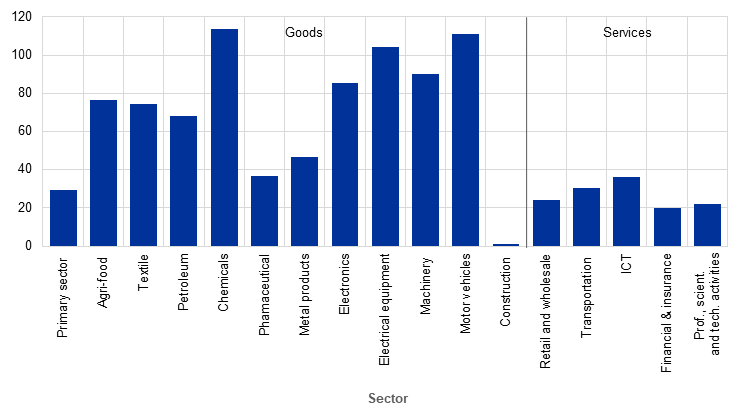
Sources: OECD TiVA 2025 and ECB calculations.
Notes: Data refer to 2022. Sector trade from input-output tables includes gross final and intermediate trade.
3 What are the barriers that impede integration of the EU Single Market?
Barriers persist within the EU Single Market.[5] They originate from a multitude of sources, including: (a) differences in national rules or regulations; (b) cumbersome administrative procedures; (c) inconsistent application of EU rules and gold-plating; and (d) national anticompetition practices that put non-domestic firms at a disadvantage. In addition, barriers can also differ across sectors. Goods markets often face divergent technical standards, non-tariff barriers and high compliance costs. Services face challenges from labour mobility restrictions and regulatory differences, which complicate cross-border business. Regulatory fragmentation can hinder trade and investment in both goods and services. This section presents a short overview of the principal barriers affecting intra-EU trade, categorised according to the source of the barriers.
A. Regulatory barriers
Regulatory barriers refer to fragmented rules or requirements that restrict the free movement of goods and services across borders. Different rules and standards across Member States may limit cross-border market access or raise compliance costs for firms. Significant disparities in product standards and technical requirements persist across the EU. A fragmented value added tax regime – with 27 distinct national frameworks – is also an obstacle to cross-border trade. For services, the recognition of professional qualifications impedes worker mobility.
B. Administrative barriers
Administrative barriers typically encompass lengthy, cumbersome or unclear procedures that complicate compliance and delivery. Administrative barriers arise typically from the procedures surrounding the implementation and enforcement of regulations. These include complex authorisation procedures, excessive documentation requirements, delays in obtaining permits or a lack of coordination between national authorities. Exporters may need import licences, conformity assessments and tailored documentation for national regulations, while lengthy product registration and a lack of digital reporting systems complicate compliance. In the field of services, residency and nationality requirements – while mostly curbed by EU law – can still arise through national rules like residency obligations for legal accountability.
C. Enforcement barriers
Enforcement barriers relate to the inconsistent application of EU rules or lack of oversight mechanisms. Differences in the interpretation and application of EU directives across Member States undermine the Single Market, as national authorities often prioritise domestic standards over EU law, creating legal uncertainty or failing to meet minimum standards. Gold-plating – the practice of adding national requirements beyond the minimum required to implement EU law – further increases costs and burdens, forcing companies to adapt to varying obligations.
D. Competition-related barriers
Competition-related barriers relate to discriminatory practices or unequal treatment that put non-domestic firms at a disadvantage. For both goods and services, legal constraints such as local language requirements, price controls and nationally restricted tax incentives or targeted subsidies raise operational costs or restrict access for foreign competitors. In the services sector, fragmentation stems from local content requirements, which are officially prohibited but are often introduced in disguised form. In sectors like energy, defence and telecommunications, public procurement processes tend to favour domestic firms. Studies indicate that only about 5% of public procurement contracts are awarded to non-domestic firms.[6]
E. Other barriers
Obstacles to the effective functioning of the Single Market are compounded by multiple layers of structural and practical barriers. Accessing clear and comprehensive information remains a major challenge within the Single Market, as businesses frequently face difficulties finding up-to-date guidance on national rules and requirements. Lengthy enforcement processes and inefficient judicial systems further fracture the regulatory landscape and undermine legal certainty. In the financial sector, the lack of a fully realised Capital Markets Union – with a single supervisor and harmonised resolution mechanisms – undermines cross-border investment and financial integration. These issues are further compounded by patchy transport and digital communication infrastructure, which restricts efficient connectivity.
Data on barriers that hinder the functioning of the Single Market are limited. Regulatory restrictions, administrative requirements and other barriers can be difficult to capture and complex to quantify. Existing indicators often rely on subjective evaluations, expert assessments or partial coverage, with limited consistency across sectors and time. Some indicators rely on expert assessments of regulatory frameworks to quantify restrictions in the services sector, while others systematically record and classify policy measures deemed harmful to trade. EU-level data focus on the implementation of and compliance with EU rules. By contrast, a few business surveys capture firms’ perceptions of administrative burdens, market access obstacles and regulatory uncertainty. The European Commission (2025a) indicates that, while over the years the EU has removed many barriers to trade in the Single Market, new sources of fragmentation continue to appear. This results in a pattern of increased barriers. Specifically, the Commission has identified a set of the “Terrible 10” barriers which persistently fragment cross-border activity despite harmonised EU rules (European Commission, 2025a). These include discriminatory authorisation procedures, disproportionate professional qualification requirements, unjustified territorial supply constraints, limits on cross-border establishment, barriers to digital and data mobility, and restrictions on the provision of services across borders.
The data that are available suggest there are still hurdles to overcome for the Single Market to function more efficiently. The Global Trade Alert (GTA) database reveals that Member States still enact trade-distortive interventions, demonstrating that internal barriers still characterise the Single Market. By impeding or disincentivising trade, these measures could translate into material costs. A substantial proportion of these measures involve subsidies and export-supporting policies, which often create competitive imbalances within the Single Market. Machinery and food products are consistently among the most affected sectors in the manufacturing industry (Chart 3).
Chart 3
Interventions hindering intra-EU trade by sector
(number of interventions)
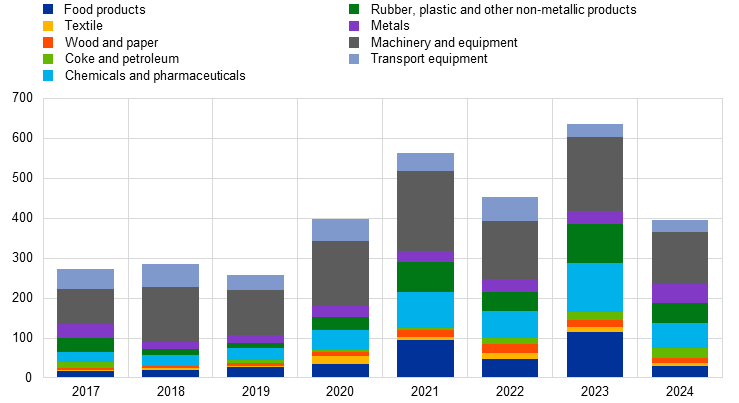
Sources: GTA and ECB calculations.
Note: Interventions classified as harmful are reported.
The data also indicate that restrictions on competition and foreign entry of firms form the bulk of the barriers within the Single Market for services. Data on barriers that hinder the functioning of the Single Market are limited also in the case of services. Still, the OECD STRI indicator can offer a useful proxy. Specifically, Chart 4 illustrates the distribution of barriers by policy area for EU countries, highlighting the relative importance of different types of barriers. Data point to a marked variation in the degree of services restrictions across EU Member States and categories. Some countries like Luxembourg and Belgium exhibit higher overall restrictiveness levels, largely driven by foreign entry and competition barriers, while others, such as Latvia and Lithuania, maintain comparatively open regulatory environments.[7]
Chart 4
2023 service trade restrictiveness
(index points)
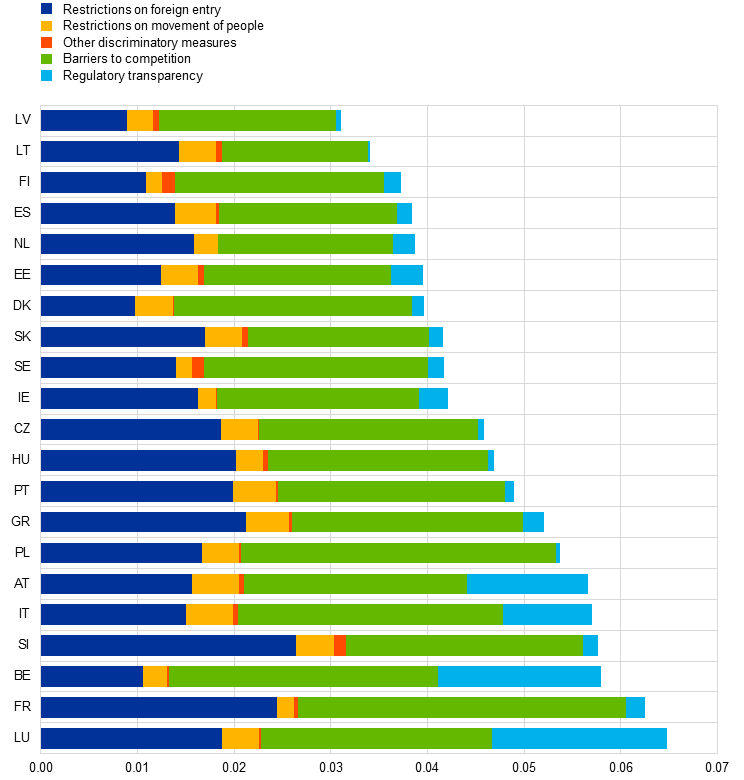
Sources: OECD and ECB calculations.
Notes: Data refer to 2023. A higher value indicates a more restricted market. The index offers a structured cross-country comparison of regulatory barriers affecting trade in services, from the perspective of the importer. It is a composite index, with scores ranging from 0, indicating a fully open economy, to 1, indicating a completely closed economy. The index summarises regulatory barriers across five specific policy areas: foreign entry, movement of people, discriminatory measures, competition and regulatory transparency.
4 Quantifying the untapped economic potential of the Single Market
Quantifying the magnitude of trade barriers is key to assessing their economic impact and identifying policies to address them. However, measuring the scale of trade barriers is challenging. As section two discussed, obstacles to trade vary across Member States and sectors and evolve as legislation and national practices change. Comprehensive and comparable indicators are limited, since many barriers – such as gold-plating, licensing complexity or differences in enforcement – are difficult to observe directly or quantify systematically.
To address the lack of data on trade barriers, the literature has adopted an indirect, model-based approach to infer their magnitude. The few existing analyses rely on the estimation of gravity models – the workhorse framework of international trade analysis.[8] These models consider the determinants of trade flows between two countries, such as economic size, distance, shared language and borders. By incorporating these determinants, the gravity model allows for the quantification of other, additional costs associated with cross-border trade between EU Member States, relative to domestic trade, including possible observable and unobservable frictions that have an impact on trade. These reflect a wide range of influences, including trade-related costs and barriers that can be amended through policy actions, such as regulatory differences and restrictions to competition, but also factors such as cultural mismatches and national preferences.
Estimates of trade costs are typically expressed relative to domestic trade and as ad valorem tariff equivalents, as if they were a percentage tariff on the value of traded products. Estimating the costs influencing cross-border trade in relation to domestic trade means in practice that the estimate captures how much more – or less – economic exchange occurs across an international border compared with trade within the same country. Estimates are often expressed as tariff equivalents to provide an intuitive metric for comparison. However, this should not be interpreted to mean that they are directly comparable to tariffs applied at customs borders. Instead, the tariff equivalent gives a simple numerical indication of the extent of the frictions that limit trade across national borders – the higher the tariff equivalent, the larger the implied trade frictions relative to domestic trade.
Studies based on these methods suggest that substantial costs to integration persist, although the range of estimates is very large. Using a gravity framework, recent studies reveal that, while intra-EU trade costs have declined over time, considerable obstacles remain, especially for services. They also vary widely. The estimated tariff equivalent costs for goods trade were 13% for EU15 and 8% for EU28 in 2017 (Head and Mayer, 2021), 44% for EU27 in 2020 (IMF, 2025), and 60% for the euro area in 2020 (Airaudo et al., 2025). Head and Mayer (2025) indicate that this dispersion reflects differences in estimation strategies, data sources, variables used as controls, estimation choices and the time periods considered. For services, trade costs remain significantly higher. Adilbish et. al (2025) estimate a tariff equivalent of 110% for services, underscoring the scale of impediments to full integration.[9] Fontagné and Yotov (2025) find that only half of the potential benefits from EU membership have been realised to date.[10]
The analysis we present in this section deploys a similar gravity specification. It uses the methodology proposed by Head and Mayer (2021) to address two major questions: (i) How has the integration of the Single Market evolved over the past 20 years?; and (ii) to what extent does the Single Market remain incomplete? The evolution of trade costs within the Single Market is estimated over time – separately for goods and services – using a gravity model, and barriers are expressed in tariff-equivalent terms.[11] In addition, the analysis provides an estimate of barriers across sectors.[12]
The estimates provide an upper bound for the level of trade costs within the Single Market. The wide range of estimates highlights the significant complexity involved in measuring trade costs. A key challenge is disentangling frictions that are amendable through policy actions (for example through regulatory change) from other structural or behavioural costs that also influence trade flows. Within the gravity framework, trade costs are estimated as a “catch-all” measure for the costs of trading, once the standard determinants have been accounted for. However, these estimates also capture non-policy-related factors that reduce trade, such as taste differences, domestic bias, limited substitutability between products, or the intrinsic limited tradability of some goods and services. As a result, gravity-based estimates overstate the true magnitude of policy-induced trade barriers, and consequently the extent to which barriers within the Single Market can be reduced through policy reforms.[13] Therefore, these estimates are best viewed as an upper bound on the costs associated specifically with trade barriers.
Given concerns about correctly judging the degree to which trade barriers can be lowered through policy actions, this article also adopts a comparative approach by evaluating intra-EU trade costs against a “friction-light” benchmark country. Several existing studies in the literature analyse the estimated scale of trade costs in isolation, which, as stated above, carries the risk of overstating the extent to which policy interventions can reduce them. In contrast, this analysis aims to compare estimated trade barriers to those of a benchmark country – defined as an EU Member State exhibiting low estimated trade costs and a high degree of trade integration. This provides a more realistic counterfactual that can demonstrate the potential for deepening EU integration if all Member States were to reduce barriers to the levels of the benchmark country.[14] The use of a benchmark in the estimation helps to mitigate some limitations related to estimating the levels of barriers as described above.[15] Indeed, for policy purposes, it may be more appropriate to focus on the integration already achieved in the chosen benchmark country rather than on the absolute level of intra-EU barriers – which partly reflect structural factors beyond the reach of policymakers.
5 Measuring trade barriers in goods markets
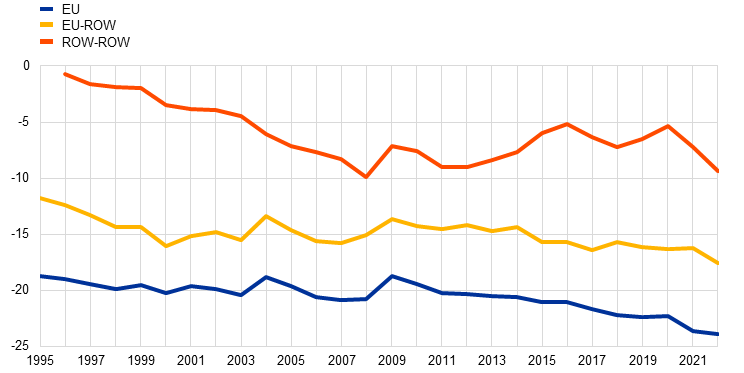
The integration of EU goods markets has progressed steadily over recent decades. Chart 5, panel a), illustrates the evolution of estimated trade costs – expressed as ad valorem tariff equivalents – within EU Member States, between EU and non-EU partners, and across countries in the rest of the world over time. In 1995, intra-EU trade costs were already almost 19% lower than those for trade between non-EU countries, reflecting the early benefits of Single Market integration (Chart 5, panel a). By 2022, this gap between intra-EU trade costs and non-EU trade costs had narrowed somewhat, while intra-EU trade costs had decreased, in absolute terms, by an additional 7 percentage points. The most substantial decreases in trade costs occurred in energy and agriculture and food products – industries that have benefited from continued policy reforms and harmonisation efforts within the Single Market. For instance, the liberalisation of the energy market, including electricity and gas, and the common agricultural policy reforms have helped to reduce trade costs for these sectors.
Chart 5
Estimated trade costs for the Single Market in goods
a) Changes in trade costs
(percentage points)
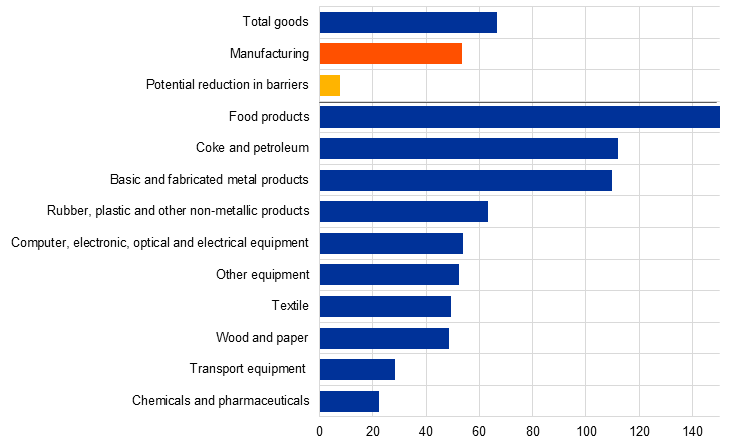
b) Estimated level of EU trade costs by sector in 2022
(percentages, percentage points)
Sources: OECD TiVA 2025 and ECB calculations.
Notes: Panel a): the chart is based on a gravity estimation (see footnote 10) and shows the change in trade barriers for intra-EU trade (blue line), in trade barriers between EU countries and the rest of the world (ROW, yellow line) and for countries in the rest of the world (red line). Each point represents a difference in trade barriers with respect to the 1995 ROW-ROW barriers. Panel b): the chart is based on a gravity estimation (see footnote 10) and shows the ad valorem tariff equivalent level of barriers to trade within the EU across subsectors, for goods as a whole, and for a regression including only the manufacturing sectors. Regression coefficients are converted into ad valorem tariff equivalents using sector-specific elasticities from Fontagné et al. (2022). The potential reduction in barriers (yellow bar) reports the difference in estimated trade costs in the Single Market between the rest of the EU and the Netherlands (the country displaying the highest integration within the EU). The difference is computed as in Yotov and Larch (2021).
Nonetheless, the empirical estimates suggest that trade costs of intra-EU trade in goods remain high. Regression results (Chart 5, panel b) indicate that in 2022 intra-EU trade frictions for goods – i.e. the costs of trading with other EU countries relative to trading domestically – remain significant, at 67% on aggregate for goods and 54% when considering only the manufacturing sector.[16] Within manufacturing, intra-EU costs for food products are the highest, with an ad valorem tariff equivalent of 150%, which may reflect the complexity of food trade within the EU and the limited scope of the common agricultural policy. In contrast, intra-EU trade costs in the chemical and pharmaceutical sectors are lower, which may reflect the significant efforts towards harmonisation and mutual recognition tools in these sectors.
Comparisons to the friction-light benchmark country – in this case the Netherlands – suggest there is scope to bolster goods trade integration. As stated above, taken in isolation estimates of the level of trade costs can overstate the extent of barriers within the Single Market that can be reduced through policy reforms. Instead, comparison to a benchmark country that has already achieved high integration may be more insightful. Looking across countries, the Netherlands is the Member State with the lowest estimated costs for trade in goods with other EU countries. To quantify the potential for reducing barriers, the gravity regression analysis compares the level of trade costs between the Netherlands and other EU Member States with that of other Member States. This approach calculates the gap between the benchmark and the average trade integration levels across the EU. The regression analysis suggests that, if other countries were to achieve similar levels of integration as this benchmark, intra-EU frictions for trade in goods could be lowered by an average of around 8 percentage points (Chart 5, panel b). That suggests there is scope for relatively substantial gains in integration from countries reaching this benchmark – an aggregate reduction of barriers to trade of 8 percentage points would be broadly similar to the progress made in deepening integration over the past two decades (Chart 5, panel a).
6 Measuring trade barriers in services markets
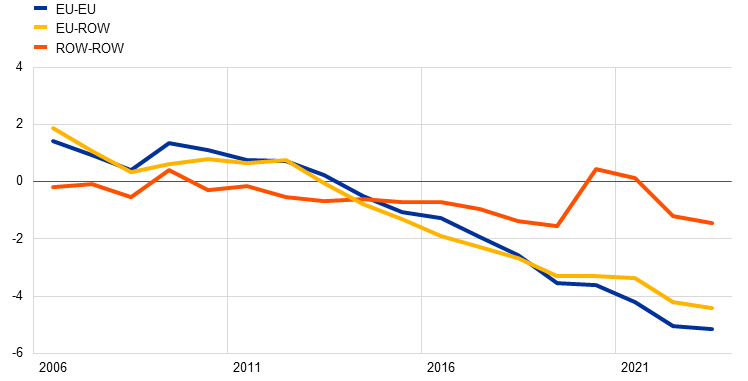
The integration of EU services markets has also advanced gradually over the past decades. In 2005 intra-EU service trade costs were slightly higher than those affecting countries in the rest of the world. By 2023, intra-EU service trade costs were estimated to have fallen by approximately 7 percentage points (Chart 6a). The most rapid integration has taken place in financial services and in information and communication, where frictions fell by 10 and 9 percentage points respectively between 2005 and 2023. In contrast, progress has been slower in the wholesale and retail sectors, professional services and transport and construction-related services.
Chart 6
Estimated trade costs for the Single Market in services
a) Changes in barriers – tariff equivalent
(percentage points)
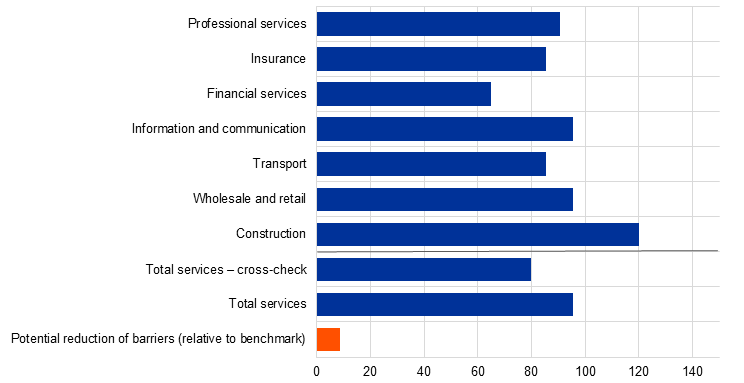
b) Estimated level of EU trade costs by sector – tariff equivalent in 2023
(percentages, percentage points)
Sources: OECD and ECB calculations.
Notes: Panel a): the chart is based on a gravity estimation (see footnote 10) and shows changes in trade costs for intra-EU trade (blue line), trade between EU countries and the rest of the world (ROW, red line) and trade between countries in the rest of the world (yellow line). Coefficients are converted into ad valorem tariff equivalents using an elasticity of 7.8 (in line with Freeman et al., 2023).[17] Each point is obtained by differencing with respect to the 2004 ROW-border coefficient. Panel b): this is also based on a gravity estimation (see footnote 10) and shows the level coefficient of an intra-EU dummy across subsectors and for the sector services as a whole. Coefficients are also converted into ad valorem tariff equivalents. The red bar shows the estimated difference between the estimated intra-EU barriers and the benchmark. The difference is computed as in Yotov and Larch (2021).
Despite this progress, substantial frictions continue to impede cross-border trade in services. Chart 6, panel b) presents estimates of the level of trade costs in 2023, expressed as ad valorem tariff equivalents. Although gradual liberalisation has taken place over recent decades, significant obstacles remain – particularly in the construction sector, where trade costs are estimated to amount to a tariff exceeding 120%. On average, intra-EU trade costs approximate an ad valorem tariff of around 95% when compared to domestic trade. This implies that trading services across EU borders is almost twice as costly as trading within national borders.[18]
The analysis also highlights untapped potential for further integration (Chart 6, panel b). Just as for goods, if taken in isolation, the estimates presented in the previous paragraph overstate the extent of barriers within the Single Market that can be reduced through policy reforms. A more realistic assessment of the untapped potential of the Single Market is provided by the benchmarking exercise. The empirical estimates again suggest that the Netherlands is the benchmark to assess the scope for deeper EU integration in services markets. This is broadly consistent with the indications provided by the OECD Service Trade Restrictiveness Index, which suggests that the Netherlands has a relatively low level of regulatory restrictiveness (Chart 4). The trade costs estimated for the benchmark remain well below the EU average. If other countries were to achieve similar levels of integration, the estimates suggest a reduction in trade costs of around 9 percentage points. As with the goods market, these estimates suggest there is scope for relatively substantial gains in integration if countries can reach this benchmark: a 9 percentage point reduction is similar to the decrease in barriers achieved in the past two decades.
7 Removing barriers to the Single Market: what is the economic impact?
To assess the potential economic gains from reducing barriers within the Single Market, we carry out model-based counterfactual simulations. The simulations are based on a computable general-equilibrium model of trade (Antràs and Chor, 2018), which captures how changes in trade costs affect the economy. The model considers several economic channels through which lower barriers influence trade and welfare. The substitution effect captures that, as cross-border trade becomes easier and cheaper across Europe, firms and consumers substitute more expensive domestically produced goods and services with cheaper imports from other EU countries. In addition, lower barriers lead to lower prices for intermediate and final goods, reducing production costs for firms and increasing real purchasing power for consumers. Together, these mechanisms raise overall efficiency, stimulate competition and expand market opportunities across Member States.
Reducing trade barriers within the Single Market, as identified in the benchmark exercises of the previous sections, could result in substantial long-term welfare gains, particularly in services. The analysis in Chart 7 evaluates the potential gains from closing the gap with the benchmark country in the goods and services markets. In practice, a counterfactual exercise evaluates the gains in terms of increased trade and welfare resulting from the reduction of trade barriers quantified in the benchmark exercise – 8 percentage points in goods and 9 percentage points in services within the EU. A reduction of barriers for goods would lead to an increase in intra-EU trade of 4.4% and estimated welfare gains of 1.3%. However, lower trade barriers for services would achieve a larger increase in trade (14.5%) and a larger welfare increase (1.8%). The higher gains from services reflect their significant potential for further integration (as services sectors face higher initial trade barriers). It also reflects the importance of services in the overall economy, as they represent a larger share of domestic expenditure and have downstream linkages. Therefore, a comparable cost reduction generates greater effective integration and broader general-equilibrium gains.
A modest reduction in Single Market barriers could compensate the likely trade losses from higher US tariffs. In the current geopolitical context, enhancing EU integration is especially important to mitigate the adverse effects of external trade tensions, such as those caused by recent US tariffs.[19] The ECB staff projections estimated that higher tariffs and uncertainty would cumulatively lower GDP by around 0.7 percentage points over the period 2025 to 2027.[20] Our simulation shows that achieving a reduction of just 2% in goods and services barriers within the Single Market could, in the long run, fully compensate for the projected impact on GDP of higher US tariffs. That would lead to an increase in intra-EU trade of around 3%. Of course, this would be unlikely to substitute for lost US trade immediately, as any structural adjustments within the Single Market would take time to materialise. Sustained regulatory, administrative and enforcement efforts would be required. Nonetheless, the estimates highlight the potential to take advantage of the vast size of the EU internal market. Trade within the EU accounts for more than half of total intra- and extra-euro area exports. Even a small increase in intra-EU trade could significantly offset external trade disruptions, demonstrating the economic potential of the Single Market.
Chart 7
Welfare effects of decreasing Single Market trade barriers
(percentage change effect of decreasing trade costs)
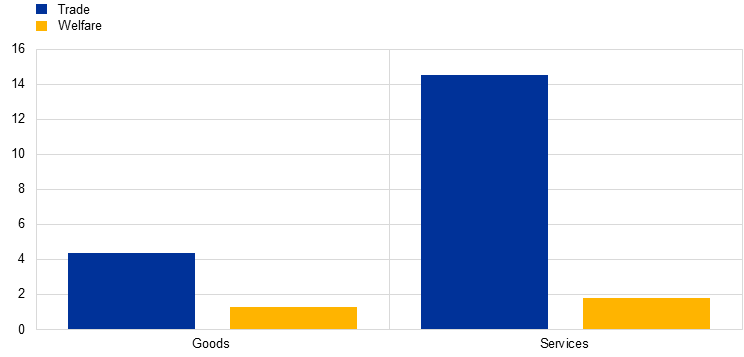
Sources: OECD TiVA 2025, Antràs and Chor (2018) and ECB calculations.
Notes: The EU aggregate welfare effect is calculated as a value added weighted average of effects obtained for Member States.
8 Conclusion
The Single Market is a vital asset for the European Union and its Member States, underpinning prosperity both within the EU and in its relations with the wider world. In the current context of elevated global uncertainty, the completion of the Single Market is more crucial than ever for advancing the EU’s principal agendas: improving living standards, enhancing resilience and competitiveness, building defence capabilities and achieving economic security.
This article helps to show the untapped potential of the Single Market. In line with earlier analyses, it estimates the evolution of trade costs within the Single Market using a gravity model framework, with frictions expressed in terms of their tariff-equivalent value. Those empirical estimates suggest that frictions to intra-EU trade remain elevated, with estimates suggesting a tariff equivalent (i.e. the higher costs of trading with other EU countries compared with trading domestically) of 67% for goods and 95% for services. However, as discussed, these figures capture a broad set of factors. Those include costs that could be addressed by policies (e.g. regulatory or administrative changes) but also factors for which it may not be feasible – or even desirable – to eliminate them by policy actions – for example, preferences, home bias and limited tradability. As a result, these estimates likely overstate the true magnitude of policy-induced barriers. As with similar studies in the literature, they are best interpreted as upper bounds for the trade frictions that can be reduced through policy action.
These findings underscore the considerable benefits for Member States in achieving greater integration. Benchmarking against an EU country that has already achieved relatively high integration – in these estimates the Netherlands – can provide a more realistic counterfactual that can demonstrate the potential for deepening EU integration. The analysis indicates that frictions could be further reduced by some 8 percentage points for goods and 9 percentage points for services if other countries were to achieve a similar degree of integration. That would represent substantial gains in integration, broadly similar to the progress made in deepening integration in goods and services markets over the past two decades. Model estimates suggest this could unlock significant economic potential, with estimated welfare gains of up to 1.3% for convergence in the goods sector and up to 1.6% in the service sector.
Moreover, the EU could derive even greater benefits from completing the Single Market and complementing it with growth-enhancing policies. The estimates of the untapped potential presented in this article are conservative, as they capture only the gains from all Member States reaching the degree of intra-EU trade achieved by the most integrated country. This falls short of the deeper integration that could be unlocked from the full potential of the Single Market and the implementation of Europe’s broader competitiveness agenda. As highlighted by Draghi (2024) and Letta (2024), achieving a truly unified market for services requires a very ambitious reduction of remaining regulatory and administrative barriers across Member States. The European Commission’s Single Market Strategy (2025b), which focuses on eliminating the ten most significant obstacles to the Single Market while revitalising the services sector and enhancing support for small and medium-sized enterprises, is a step in the right direction and deserves strong support.
Finally, further data collection on the precise nature and intensity of remaining barriers would be valuable. Based on more granular data, a deeper analysis of the existing barriers and their relative magnitude could be pursued. This would help to further inform the debate on specific measures.
References
Adilbish, O.E., Cerdeiro, D.A., Duval, R.A., Hong, G.H., Mazzone, L., Rotunno, L., Toprak, H.H. and Vaziri, M. (2025), "Europe’s Productivity Weakness: Firm-Level Roots and Remedies," IMF Working Papers, No 040, International Monetary Fund.
Airaudo, F., Gaillard, A., Santacreu, A.M. and de Soyres, F. (2025), “Recent Evolutions in the Global Trade System: From Integration to Strategic Realignment”, Working Papers, 2025-027, Federal Reserve Bank of St. Louis.
Anderson, J.E. and Van Wincoop, E. (2003), “Gravity with Gravitas: A Solution to the Border Puzzle”, American Economic Review, 93(1), pp. 170-192.
Arampatzi, A.S. et al. (2025), “Capital Markets Union: A Deep Dive - Five Measures to Foster a Single Market for Capital”, Occasional Paper Series, No 369, ECB.
Campos, N.F., Coricelli, F. and Moretti, L. (2014), “Economic Growth and Political Integration: Estimating the Benefits from Membership in the European Union Using the Synthetic Counterfactuals Method”, IZA Discussion Paper Series, No 8162, Institute for the Study of Labor (IZA).
Dahlberg, E. et al. (2020), Legal obstacles in Member States to Single Market rules, Publication for the Committee on Internal Market and Consumer Protection, Policy Department for Economic, Scientific and Quality of Life Policies, European Parliament, Luxembourg.
Dorn, F., Flach, L. and Gourevich, I. (2024), “Building a Stronger Single Market: Potential for Deeper Integration of the Services Sector within the EU”, EconPol Policy Report, No 52, November.
Draghi, M. (2024), The Future of European Competitiveness, European Commission, September.
European Centre for International Political Economy (2021), Participation of foreign bidders in EU public procurement, European Commission.
European Commission (2025a), The 2025 Annual Single Market and Competitiveness Report, COM (2025) 26 final, Brussels, 29 January.
European Commission (2025b), The Single Market: Our European home market in an uncertain world – A Strategy for making the Single Market simple, seamless and strong, COM(2025) 500 final, Brussels, 21 May.
Filip, P. et al. (2025), “Why a more competitive economy matters for monetary policy”, The ECB Blog, ECB, 11 February.
Fontagné, L. and Yotov, Y.V. (2024), “Reassessing the Impact of the Single Market and Its Ability to Help Build Strategic Autonomy”, CESifo Working Paper Series, No 11151, May.
Fontagné, L. and Yotov, Y.V. (2025), “The Low-Hanging Fruit of the Single European Market: New Methods and Measures”, Working Paper No 202522. Center for Global Policy Analysis, LeBow College of Business, Drexel University.
Freeman, R. et al. (2025), “Unlocking New Methods to Estimate Country-Specific Effects and Trade Elasticities with the Structural Gravity Model”, Journal of Applied Econometrics, Vol. 40 Issue 6, pp. 669-684.
Head, K. and Mayer, T. (2021), “The United States of Europe: A Gravity Model Evaluation of the Four Freedoms”, Journal of Economic Perspectives, 35(2), pp. 23-48.
Helliwell, J.F. (1998), How Much Do National Borders Matter?, Brookings Institution Press.
in ’t Veld, J. (2019), “Quantifying the Economic Effects of the Single Market in a Structural Macromodel”, European Economy Discussion Papers, No 094, European Commission, Directorate-General for Economic and Financial Affairs.
International Monetary Fund (IMF) (2024), “Europe’s Choice: Policies for Growth and Resilience”, IMF news article, 16 December.
Lagarde, C. (2025), “Remarks by Christine Lagarde, President of the ECB, at the panel on the ‘Global Economic Outlook’ at the 40th Annual G30 International Banking Seminar”, Washington DC, 18 October.
Larch, M., Tan, S. and Yotov, Y. (2023), “A simple method to ex-ante quantify the unobservable effects of trade liberalization and trade protection”, Journal of Comparative Economics, Volume 51, Issue 4.
Lehtimäki, J. and Sondermann, D. (2020), “Baldwin vs. Cecchini Revisited: The Growth Impact of the European Single Market”, Working Paper Series, No 2392, ECB, April.
Letta, E. (2024), Much more than a market: speed, security, solidarity, European Commission, April.
McCallum, J. (1995), “National Borders Matter: Canada–U.S. Regional Trade Patterns”, American Economic Review, 85(3), pp. 615-623.
Mion, G. and Ponattu, D. (2019), “Estimating economic benefits of the Single Market for European countries and regions”, Bertelsmann Stiftung Policy Paper.
Monteagudo, J., Rutkowski, A. and Lorenzani, D. (2012), “The economic impact of the Services Directive: A first assessment following implementation”, Economic Papers, No 456, European Commission, Directorate-General for Economic and Financial Affairs.
Nitsch, V. (2000), “National Borders and International Trade: Evidence from the European Union”, Canadian Journal of Economics, 33(4), pp. 1091-1105.
Parsons, C. and Smith, A. (2022), “The ‘Completeness’ of the EU Single Market in Comparison to the United States”, Single Market Economics Papers, WP2022/7, Directorate-General for Internal Market, Industry, Entrepreneurship and SMEs (European Commission), Chief Economist Team.
Santamaria, M., Ventura, J. and Yeşilbayraktar, U. (2023), “Exploring European Regional Trade”, Journal of International Economics, 146(C).
Tinbergen, J. (1962), Shaping the World Economy: Suggestions for an International Economic Policy, The Twentieth Century Fund.
Wolf, H.C. (2000), “Intranational Home Bias in Trade”, The Review of Economics and Statistics, 82(4), pp. 555-563.
Wolfmayr, Y. and Pfaffermayr, M. (2022), “The EU Services Directive: Untapped Potentials of Trade in Services”, FIW Research Reports, No 03, July.
Legal Disclaimer:
EIN Presswire provides this news content "as is" without warranty of any kind. We do not accept any responsibility or liability for the accuracy, content, images, videos, licenses, completeness, legality, or reliability of the information contained in this article. If you have any complaints or copyright issues related to this article, kindly contact the author above.
