

Europe’s venture capital gap and the financing of high-growth firms
Prepared by Adam Baumann, Zakaria Gati, Francesca Vinci and Gerome Wolf
A deeper and more integrated venture capital (VC) market could help the EU finance innovative firms, support productivity growth and retain more value from its innovation ecosystem. This box shows that Europe’s VC challenges reflect gaps in later-stage financing, a relatively narrow institutional investor base and limited cross-border investment within the EU. It also highlights the productivity potential of VC-backed firms, underscoring the case for policy action, in line with the recommendations of the Kukies-Noyer report (2026).
The VC gap between the EU and the United States is substantial. VC funds located in the United States are more numerous and larger – total fund size there amounts to approximately €930 billion, around six times as much as the roughly €150 billion of funds located in the EU (Banu et al., 2026).[1] Yet Europe’s VC challenge goes beyond aggregate scale.
Relative to the United States, the EU VC market is less equipped to finance firms through their later growth stages, when funding requirements rise substantially. The gap with the United States widens in later-stage VC funding rounds (Chart A), which require larger amounts of capital. This creates a financing bottleneck for firms with high growth potential and substantial investment needs, as is already well documented in the literature (see, for instance, Böninghausen et al., 2025).
Chart A
Gap in aggregate venture capital deal value between target firms in the EU and the United States (on average over the period 2019-2024)
(EUR billions)
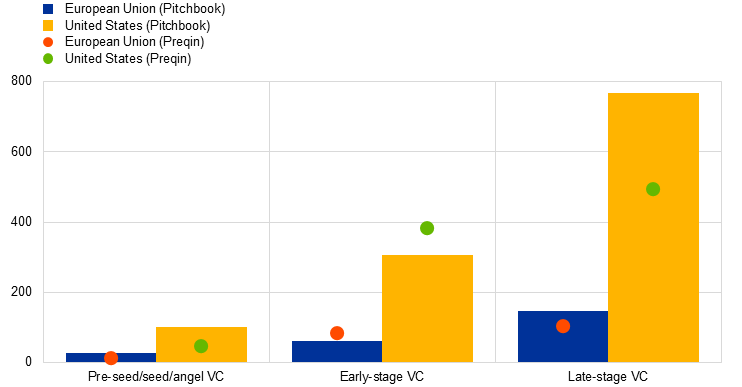
Sources: Pitchbook and Capital IQ Preqin data.
Notes: Sum of VC investments made for EU and US target companies, covering pre-seed/seed/angel VC (initial financing received), early-stage VC and late-stage VC. Data are for January 2019 to December 2024.
One important factor behind the smaller size of EU VC funds is the composition of their investor base. As discussed by Banu et al. (2026), US VC funds benefit from more participation by pension funds and foundations, partly because differences in pension systems and regulatory reforms have allowed them to play a more active role as investors in these markets. These investors can provide sizeable funding, flexibility and risk tolerance, meeting the needs of young, fast-growing and innovative firms with the greatest scale-up and productivity potential. In Europe, this is only partly offset by greater participation by government entities, including the European Investment Fund and public-backed investors.
The scarcity of EU investors capable of providing scale-up financing pushes firms to seek funding from abroad. Foreign investors often provide the additional funding needed by EU scale-ups, while foreign acquisitions and listings remain prevalent exit routes in Europe (Fratto et al., 2024 and Chart B). There is also stark heterogeneity within Europe: some small but highly developed VC markets, such as Estonia, remain heavily dominated by US investors. Successful start-ups in these markets often target global expansion early, which increases their demand for investors (such as US VC funds) with deeper pockets, sector expertise and access to international networks.
Chart B
EU venture capital deal value breakdown by lead investor geography (2019-2024)
(left-hand scale: percentage shares; right-hand scale: percentages)

Sources: Pitchbook data and ECB staff calculations.
Notes: Percentage share of aggregate venture capital value is based on the origin of the lead or sole investor and the aggregate deal value of the target country as a percentage of its GDP. Data are from January 2019 to December 2024.
While foreign VC can bring several benefits, it can also carry risks for European productive capacity. An internationally diversified investor base can provide capital, expertise, networks and access to global markets. However, heavy reliance on non-EU investors, especially at later stages, may create strategic vulnerabilities, particularly where local scale-up financing is weak. US and other foreign VC investors may increase the likelihood of successful European start-ups relocating headquarters, management functions, talent, intellectual property or future listing activity outside the EU. The concern, also reflected in Weik et al. (2024) and Angeloni et al. (2026), is therefore not foreign investment per se, but Europe’s capacity to retain the economic benefits generated by firms created, developed and initially financed within its own innovation ecosystem.
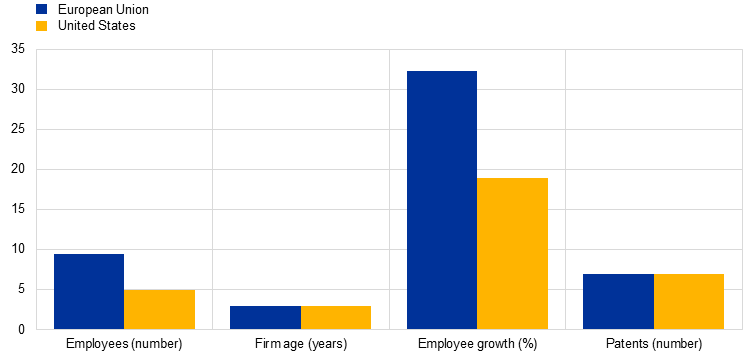
Data show that even when they have the same levels of innovative capacity and maturity as their US peers, larger and faster-growing EU firms fail to secure VC funding, suggesting higher barriers to financing. Chart C shows that among firms that do not obtain VC financing, the median EU firm is nearly twice as large in terms of employment and grows about 15 percentage points faster, while being similar in terms of age and patenting activity. This suggests that the EU has a sizeable pool of mature, high-potential firms that could benefit from deeper and more accessible VC markets. Strengthening the EU’s VC ecosystem could therefore unlock additional growth by helping more firms secure the financing they need to scale up.
Chart C
Characteristics of firms with failed venture capital deals
(medians)
Source: Pitchbook and ECB staff calculations.
Notes: Median characteristics of firms that have had at least one failed venture capital deal between the years 2010 and 2026 in the EU and the United States. Data are from January 2010 to May 2026.
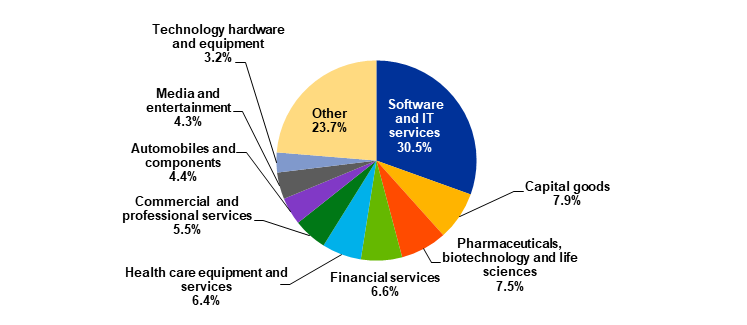
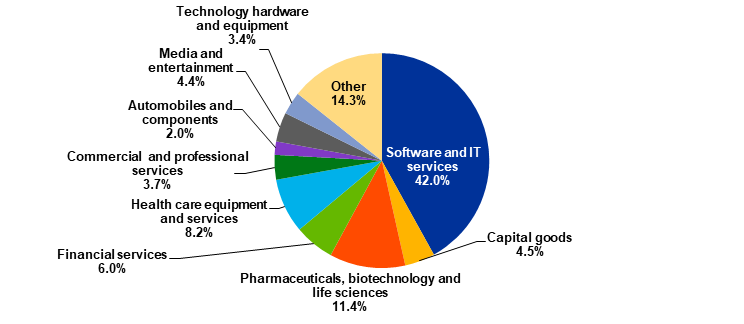
Differences in industrial structure also shape how VC is allocated and, by extension, its potential to support high-growth sectors. Europe’s stronger traditional industrial base means that VC funding is less concentrated in high-tech, high-growth sectors than it is in the United States. While software and IT services attract the largest share of VC funding on both sides of the Atlantic, the EU allocates relatively more to sectors such as automotive and capital goods (Chart D). The share of VC going to software and IT services has stalled in the EU since 2020 but has risen in the United States, possibly contributing to the transatlantic productivity gap (Chart E and Schnabel, 2024).
Chart D
Share of aggregate venture capital deal value by target firm sector (2020-2025)
a) European Union
(percentage shares)
b) United States
(percentage shares)
Sources: Pitchbook data and ECB staff calculations
Notes: Proportion of venture capital deal value for EU and US target firms, split by the nine most prominent EU (Global Industry Classification Standard level 2) sectors. The latest observations are for December 2025.
Chart E
Share of aggregate venture capital deal value going to software and IT services sector over time
(index, 2020 = 100)
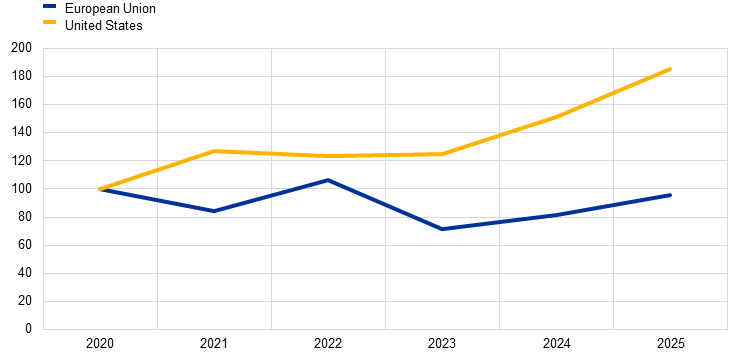
Sources: Pitchbook data and ECB staff calculations.
Notes: Percentage of venture capital deal value invested in software and IT services over time, for EU and US target firms. The latest observations are for December 2025.
VC allocation supports productivity when capital reaches firms in sectors and stages with the strongest scale-up potential. Firm-level evidence shows that EU VC financing is more likely to go to younger, faster-growing firms and to firms operating in ICT sectors (Chart F). This suggests that available VC generally supports firms with the greatest capacity to scale new technologies and raise productivity. The fact that more leveraged firms are also more likely to receive VC funding further highlights the importance of equity finance when growth opportunities begin to exceed what debt can sustain. Overall, the evidence suggests that a deeper VC market in Europe could boost productivity by enabling more high-potential firms to expand.
Chart F
Firm characteristics associated with receiving venture capital financing
(odds ratios)

Sources: Capital IQ Preqin data, Orbis data and ECB staff calculations.
Notes: Odds ratios are obtained from a logistic regression of firms receiving venture capital for the first time; observations after they receive venture capital for the first time are excluded. The reference group includes EU firms in Orbis data who have not received venture capital (yet), excluding firms with more than 250 employees. Explanatory variables are one-year-lagged, standardised (or binary) firm characteristics, with year, country and sector fixed effects. The grey lines represent 95% confidence intervals. Preqin deal-level data are name-matched to Orbis firm-year data, retaining 25% of Preqin firms. The sample is restricted to small and medium-sized enterprises with 250 employees or fewer. The ICT sector equals 1 for firms with ICT-related activities according to the standard statistical classification of economic activities in the EU (NACE). Odds ratios above/below 1 indicate higher/lower odds of firms receiving venture capital for the first time. The latest observations are for December 2024.
Europe should not merely increase the overall scale of VC – it should address the segments where gaps are most pronounced while improving the wider market environment in which VC operates. Europe needs larger VC funds and a broader institutional investor base, including pension funds especially, to provide the volumes of risk capital required by firms as they expand.[2] Targeted reforms could help channel a larger share of Europe’s long-term pension savings into equity financing, including venture capital. These efforts should be complemented by measures to facilitate deeper cross-border investment within the EU and more targeted support for strategic high-growth sectors.[3] More broadly, the savings and investments union could help mobilise long-term European savings and channel them more effectively towards innovative firms with scale-up potential.
References
Angeloni, I. and Cavallini, A. (2026), Feasible Steps to Finance Innovation in Europe: Six Proposals to Strengthen EU Capital Markets, Institute for European Policymaking, Bocconi University, 9 January.
Banu, E., Derin, T., Evrard, J., Lambert, C., Legran, D. and Schuster, W.E. (2026), “Exploring the investor landscape for venture capital,” Financial Integration and Structure in the Euro Area 2026, ECB, 7 May.
Böninghausen, B., Evrard, J., Gati, Z., Gori, S., Lambert, C., Legran, D., Schuster, W.E. and van Overbeek, F. (2025), “Should we mind the gap? An assessment of the benefits of equity markets and policy implications for Europe’s capital markets union,” Occasional Paper Series, No 373, ECB.
Fratto, C., Gatti, M., Kivernyk, A., Sinnott, E. and van der Wielen, W. (2024), “The scale-up gap: Financial market constraints holding back innovative firms in the European Union”, Economics –Thematic Studies, European Investment Bank, 24 July.
Kukies, J. and Noyer, C. (2026), Financing innovative ventures in Europe: Recommendations to close the scaleup financing gap, deepen the savings and investments union and strengthen Europe’s competitiveness, Federal Ministry of Finance, January.
Schnabel, I. (2024), “From laggard to leader? Closing the euro area’s technology gap”, inaugural lecture of the EMU Lab at the European University Institute, Florence, 16 February.
Vanacker, T.R. and Manigart, S. (2010), “Pecking order and debt capacity considerations for high-growth companies seeking financing”, Small Business Economics, Vol. 35, No 1, pp. 53-69.
Weik, S., Achleitner, A.-K. and Braun, R. (2024), “Venture capital and the international relocation of startups”, Research Policy, Vol. 53, No 7.
Legal Disclaimer:
EIN Presswire provides this news content "as is" without warranty of any kind. We do not accept any responsibility or liability for the accuracy, content, images, videos, licenses, completeness, legality, or reliability of the information contained in this article. If you have any complaints or copyright issues related to this article, kindly contact the author above.
